
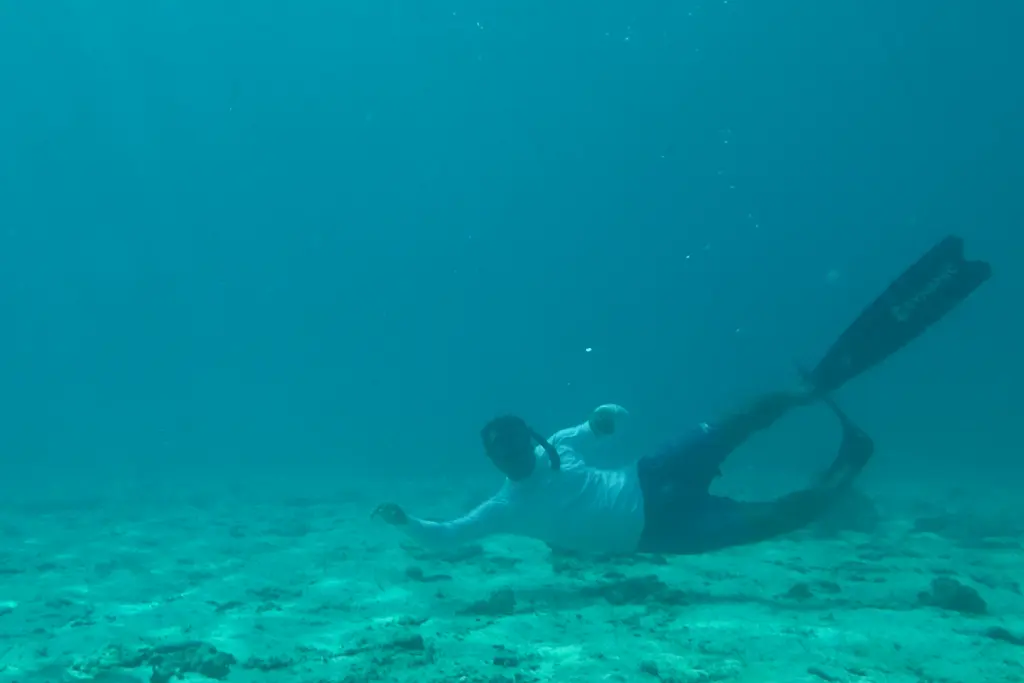
The Daymaniyat Islands consistently rank as the Arabian Peninsula’s premier diving destination, and for certified divers visiting Oman, this UNESCO-class marine reserve offers world-class underwater experiences just 30 minutes from Muscat. Our certified scuba diving trip provides two full tank dives at different sites within the reserve, where 15-20 meter visibility reveals thriving coral reefs, green sea turtles, hawksbill turtles, whitetip reef sharks, eagle rays, and an extraordinary diversity of marine life.
Whether you’re a traveling diver researching Oman’s best sites or a Muscat-based expat seeking regular dive trips, the Daymaniyat Islands deliver consistent quality that rivals far more remote destinations. The protected status of these nine islands has preserved reef health and fish populations at levels rarely seen elsewhere in the Gulf region, creating underwater environments where turtles cruise past on every dive, coral coverage remains extensive, and marine biodiversity exceeds what you’d find at many celebrated Indo-Pacific sites.
Our two-dive format maximizes your bottom time and site variety. The first dive typically explores deeper walls or dramatic topography where pelagic species cruise and turtles congregate. After a surface interval with refreshments — including a beach stop from November to April — the second dive visits a different site with distinct characteristics, often shallower reefs perfect for macro photography and coral observation. With year-round operation, professional equipment, and small group sizes, this is how certified divers experience the Daymaniyat Islands properly.
Any diving certification is accepted — PADI, SSI, NAUI, CMAS, or equivalent agencies. Simply present your certification card, and we’ll take care of everything else.
Why Certified Divers Choose Daymaniyat Islands
Best Diving in the Arabian Peninsula
The Daymaniyat Islands hold a well-earned reputation as the Gulf region’s finest diving destination. While neighboring countries offer diving opportunities, none match the combination of accessibility, marine biodiversity, and reef health found here. The islands’ UNESCO-class marine reserve status — maintained since 1996 — has preserved underwater environments that elsewhere in the Arabian Gulf have degraded due to coastal development, fishing pressure, and climate stress. International dive publications consistently feature the Daymaniyat Islands in articles about the Middle East’s best diving, and experienced dive operators throughout the region bring repeat clients here specifically because the sites deliver reliable quality. For certified divers based in Muscat or traveling through Oman, this represents a rare opportunity: world-class diving without the logistical complexity and expense of reaching the Maldives, Red Sea, or Indo-Pacific destinations. The Daymaniyat Islands prove that exceptional diving exists closer than most divers realize.
Exceptional Visibility and Conditions
Visibility at the Daymaniyat Islands typically ranges from 15-20 meters, with occasional days exceeding 25 meters during optimal conditions. For the Arabian Gulf region, this clarity is remarkable — far superior to what divers encounter at many other regional sites where visibility often struggles to reach 10 meters. The clear water results from the islands’ offshore location, minimal coastal runoff, and strong tidal exchanges that constantly refresh the water column. Beyond visibility, diving conditions favor extended bottom time and relaxed profiles. Water temperatures remain comfortable year-round, ranging from 24°C in winter months to 28°C in summer, eliminating the need for thick wetsuits. Most sites feature minimal current, allowing for easy navigation, low air consumption, and stress-free diving that underwater photographers particularly appreciate. The calm conditions don’t diminish the experience — healthy reefs and abundant marine life exist independent of challenging conditions. From November through April, seas are especially calm, creating ideal circumstances for surface intervals and comfortable boat transits.
Protected Marine Reserve Means Pristine Reefs
The Daymaniyat Islands’ protected status isn’t merely a bureaucratic designation — it’s actively enforced protection that produces tangible underwater results. No fishing occurs within the reserve boundaries. No anchoring damages coral. No extraction depletes populations. The outcome after decades of protection is immediately visible underwater: coral coverage remains extensive with healthy polyp extension, fish populations display natural size distributions rather than being fished down to juveniles, and marine life behaves without the skittishness that characterizes heavily dived or fished areas. Green sea turtles and hawksbill turtles, both endangered species, are so habituated to divers that close encounters occur on virtually every dive — not because we chase them, but because they’ve learned that divers within the reserve pose no threat. Whitetip reef sharks rest under ledges rather than fleeing at the first bubble exhalation. This is what successful marine protection looks like underwater, and it’s increasingly rare globally.
Diverse Dive Site Portfolio
The Daymaniyat Islands aren’t a single dive site — they’re an archipelago of nine islands creating dozens of named dive locations with distinct characteristics. Vertical walls drop from shallow plateaus into deeper water where pelagic species cruise. Coral gardens sprawl across mid-depth reefs with staghorn and table corals creating complex three-dimensional structures. Rocky pinnacles rise from sandy bottoms, serving as cleaning stations and aggregation points. Channel systems between islands funnel nutrients and create dynamic environments. This variety means the two dives on any given trip explore fundamentally different underwater landscapes with different species assemblages and photographic opportunities. Dive operators select sites based on current conditions, wind direction, swell, and group experience levels, ensuring you always dive the best available sites rather than following a rigid itinerary. For divers who return multiple times, the site variety prevents repetition — you can dive the Daymaniyat Islands dozens of times and continue discovering new topography and encountering different marine life.